


The Browning of America: Understanding Fear, Discrimination, and America's Demographic Transformation
America has always been a nation shaped by change. Every generation has witnessed waves of immigration, migration, and social transformation that altered the country's cultural and political landscape. Yet few developments have generated as much discussion as the nation's ongoing demographic evolution.
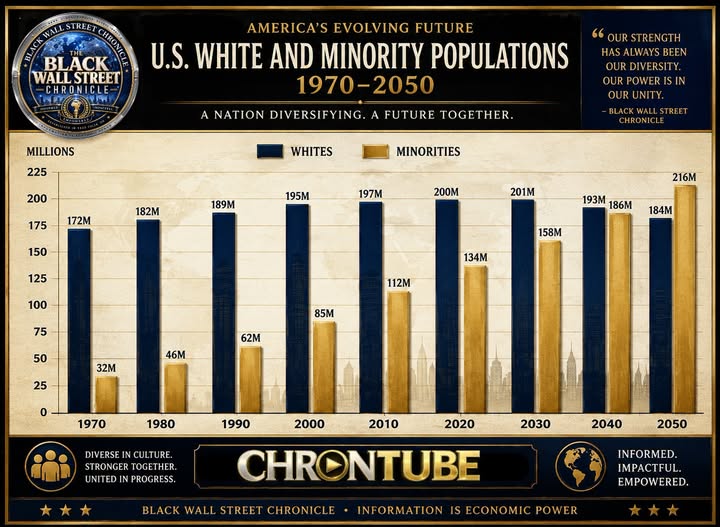
Over the past several decades, census data has documented the rapid growth of Hispanic, Black, Asian, Native American, multiracial, and other minority populations. Meanwhile, the White population has grown much more slowly and, according to many demographic projections, may eventually represent less than half of the total population.
For some observers, these trends symbolize a more inclusive America. For others, they create uncertainty about identity, culture, economics, and power.
Understanding these reactions requires examining history rather than simply assigning blame.
Throughout history, dominant groups often experience anxiety when long-standing social structures appear to be changing. Political scientists and sociologists have studied what is sometimes called "status threat," the perception that one's traditional social position is becoming less secure due to demographic or cultural change.
This fear does not necessarily arise from personal prejudice alone. It may also stem from concerns about economic security, cultural continuity, political representation, or unfamiliarity with rapid change.
History Provides Many Examples
The arrival of Irish immigrants in the nineteenth century produced widespread discrimination.
Italian immigrants were once viewed with suspicion.
Jewish Americans encountered quotas and exclusion.
Asian Americans faced discriminatory laws and exclusionary immigration policies.
African Americans endured centuries of slavery followed by segregation and systematic discrimination.
Each period reflected tensions between established populations and emerging communities.
The current demographic transformation represents another chapter in this long American story.
Economic Uncertainty and Demographic Fear
Economic uncertainty often magnifies demographic fears.
When wages stagnate or industries disappear, individuals sometimes attribute their struggles to newcomers or changing populations rather than broader economic forces such as automation, globalization, technological disruption, or policy decisions.
Political campaigns may also intensify these concerns by framing demographic change as a threat rather than a natural consequence of birth rates, immigration, and generational shifts.
Media, Polarization, and Public Perception
Media narratives can further amplify polarization.
Social media algorithms often reward emotionally charged content, encouraging sensational claims rather than thoughtful discussion. As a result, fears about demographic change may become exaggerated or disconnected from everyday lived experiences.
At the same time, minority communities continue to face discrimination that has deep historical roots.
Housing segregation, unequal educational opportunities, disparities in healthcare access, wealth inequality, and employment discrimination remain persistent issues documented by researchers.
These inequalities influence perceptions on all sides, contributing to mistrust and misunderstanding.
The Meaning of the "Browning of America"
The concept of the "browning of America" is therefore more than a demographic statistic.
- Changing neighborhoods.
- Changing schools.
- Changing workplaces.
- Changing political coalitions.
- Changing consumer markets.
- Changing religious institutions.
- Changing cultural expressions.
For many younger Americans, these changes feel ordinary because diversity has been a consistent feature of their lives.
For some older Americans, however, the pace of change may feel unsettling.
Neither reaction should be dismissed without understanding the underlying experiences that shape them.
Understanding Human Group Behavior
Psychologists note that humans naturally categorize themselves into groups. This tendency can foster belonging but may also create divisions when differences become politicized or perceived as threatening.
Education and interaction often reduce these fears.
Research consistently shows that meaningful contact across racial and ethnic lines tends to reduce prejudice by increasing familiarity and empathy.
Diversity and America's Economic Future
America's future economy will likely depend on the contributions of an increasingly diverse workforce.
Entrepreneurship among Black, Hispanic, Asian, and immigrant communities has expanded significantly over recent decades, contributing to innovation, job creation, and local economic development.
Diversity is already reshaping American business, technology, education, entertainment, and healthcare.
Rather than viewing demographic change solely through the lens of competition, many economists argue that population diversity can strengthen economic resilience and global competitiveness.
Black Wall Street: A Historical Lesson
Black Wall Street itself offers an important historical lesson.
The original Greenwood District in Tulsa demonstrated the economic power of Black entrepreneurship during an era of legal segregation and exclusion. Its success illustrated that opportunity, investment, and community development could generate prosperity despite systemic barriers.
Today's America, Tomorrow's Questions
Today's America faces different challenges but similar questions.
Can diverse communities build shared prosperity?
Can economic opportunity reduce social tension?
Can education replace fear with understanding?
Can inclusion strengthen rather than weaken national unity?
The answers will depend less on demographic statistics than on leadership, public policy, civic engagement, and interpersonal relationships.
From Fear to Understanding
Fear has often accompanied change throughout American history.
Yet history also shows that successive generations have expanded the definition of who belongs within the American story.
The nation's diversity today reflects centuries of migration, resilience, adaptation, and cultural exchange.
While disagreements over immigration, identity, and public policy will undoubtedly continue, constructive dialogue offers a more productive path than division.
Communities thrive when residents invest in education, entrepreneurship, civic participation, and mutual respect.
The America We Choose to Build
America's demographic future is not merely about numbers on a chart.
It is about millions of families seeking opportunity, children growing up in increasingly multicultural neighborhoods, businesses serving diverse customers, and communities learning to navigate change together.
The challenge is not whether America will become more diverse—it already has.
The challenge is whether that diversity will become a source of innovation and shared prosperity or a source of polarization and mistrust.
History suggests that periods of demographic transformation can be difficult, but they also create opportunities for renewal.
The future of America will ultimately be shaped not simply by changing population statistics, but by the willingness of its people to build institutions and communities that uphold equality, fairness, and opportunity for everyone.
