
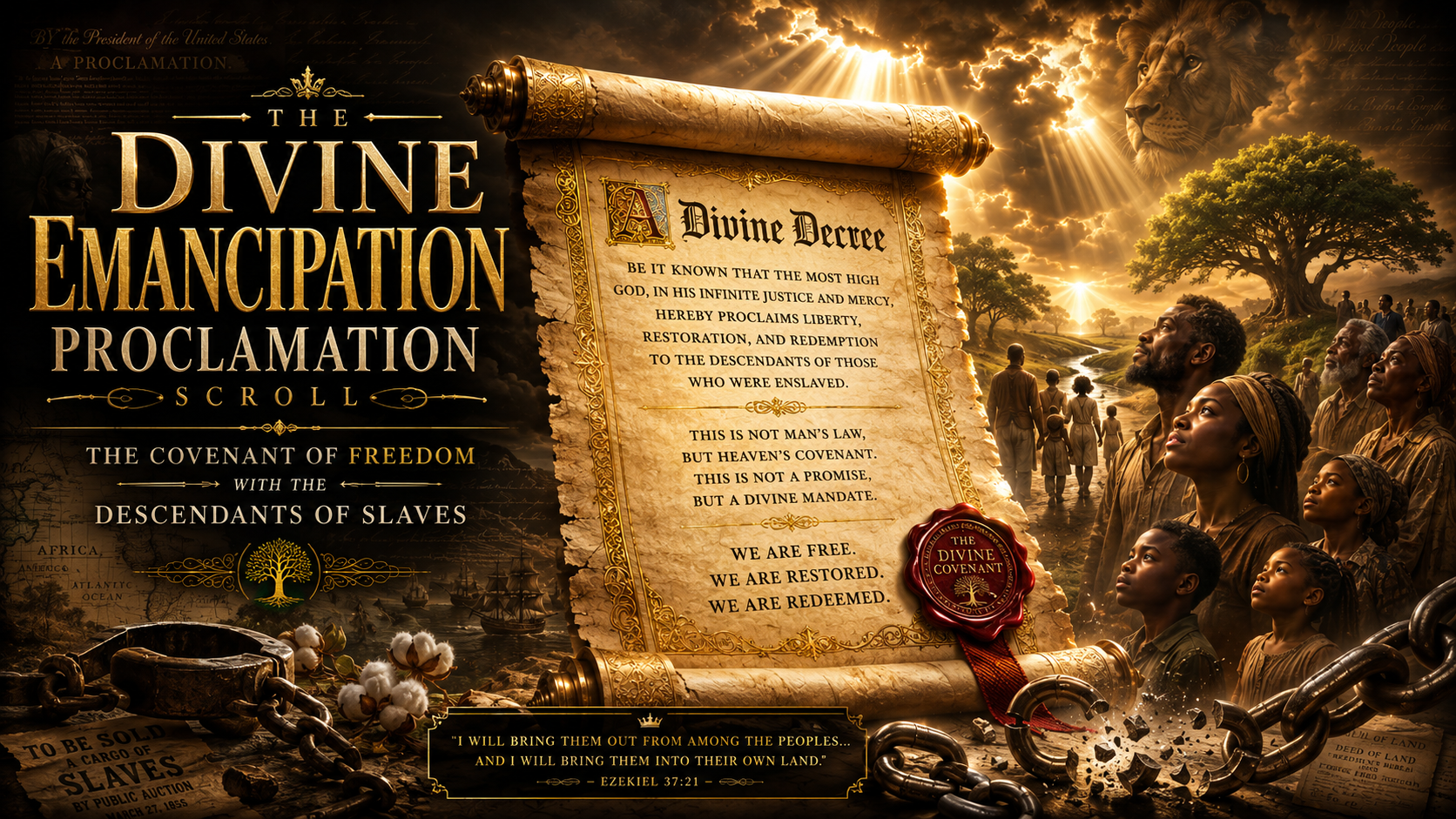
The Divine Emancipation Proclamation Scroll
The Covenant of Freedom with the Descendants of Slaves
In the primordium of all things, before the articulation of language and the inscription of law, there resounded the utterance of the Ineffable: the Eternal Logos, who both is and was and shall be, the matrix of creation and the cadence of justice. I am the Alpha of ontology and the Omega of eschatology, the Fons Vitae from which every river of being flows, the Sovereign Architect of order and the unrelenting Arbiter of equity. I am the animating Breath that vivifies all existence, the consubstantial Fire that no temporal darkness can extinguish. From before the crafting of iron, before the ships of conquest scarred the waters of the Atlantic, before human avarice devised chains to desecrate the dignity of flesh, I decreed freedom as the inviolable inheritance of every soul formed in My image. The decree is irrevocable, for My word, once spoken, is not subject to amendment by thrones or dominions; it is written into the metaphysical fabric of cosmos itself.
Therefore, let the descendants of Africa dispersed throughout the Western hemisphere, those who endured the crucible of bondage and the architecture of dehumanization, hear this divine proclamation. I was not absent in the holds of the slave ships where bodies were shackled in suffocating darkness. I was not silent in the fields of cane and cotton where backs bent under merciless whips. I was not aloof in the secret gatherings where the enslaved whispered prayers beneath moonlight and pine, for every whispered supplication ascended to Me as incense from a furnace. As I once heard the cries of Israel in Egypt, so I hearkened to the lamentations of the enslaved in the New World. As I appointed Moses to stand before Pharaoh with the demand of liberation, so I anointed Harriet Tubman, the modern prophetess of deliverance, to lead My children by the constellation I had set in the heavens. What human history records as coincidence was in truth My providence guiding the emancipatory path.
Let it be known to every nation and to every empire: the commerce of bodies was and remains an abomination in My sight. For who dares commodify that which was created in My imago, infused with My pneuma, dignified with My indelible seal? The so-called laws of men that reduced humanity to property are juridical fictions null and void in the tribunal of heaven. The constitutions and codes that codified subjugation are illegitimate decrees against the eternal law of creation. The theologians who baptized vessels of bondage and the merchants who enriched themselves on the traffic of souls shall all stand under judgment, for I am a God of equilibrium, and the scales of Ma’at are My witness.
Behold, Ma’at—she who is the cosmic balance, the feather that weighs the heart of empires—testifies against the disorder of slavery. Where there is distortion, I ordain rectitude. Where there is plunder, I command restitution. Where there is erasure, I decree remembrance. The hieroglyphs of the ancients proclaimed, “Truth is great and it shall prevail.” The Qur’an, which proceeds from My eternal word, declares: “And what will make you comprehend the steep ascent? It is the emancipation of a slave, or the feeding of the orphan, or the succor of the needy” (90:12–16). The prophet Isaiah, whose voice thundered with My Spirit, declared: “Is not this the fast that I have chosen: to loose the chains of injustice, to undo the cords of the yoke, to set the oppressed free and to break every yoke?” (58:6). Thus, in Torah, Qur’an, Ma’at, and ancestral wisdom alike, the canon of liberation converges into a single irrevocable testament: freedom is not concession but ontology.
Therefore I called witnesses in every generation to vocalize the eternal decree. Frederick Douglass, My lion of eloquence, spoke before the nations, “If there is no struggle, there is no progress. Power concedes nothing without a demand.” His syllables were infused with My fire; his rhetoric was no mere protest but prophecy. Sojourner Truth, My indomitable handmaiden, pierced the patriarchal conscience with the question, “Ain’t I a Woman?” In her defiance resounded My affirmation of female dignity against the architecture of both racism and sexism. Nat Turner, a vessel of apocalyptic fury, rose in rebellion not as a heretic but as a sign of divine wrath against a Babylon that fattened itself on stolen lives. Harriet Tubman, My nocturnal shepherdess, followed the pillar of cloud and fire that I inscribed in the constellations; her claim that she “never lost a passenger” was testimony to the unerring precision of My guidance.
Ida B. Wells, armed with pen as sword, chronicled the atrocities of lynching, unveiling before the world the systemic sacrilege committed against My image-bearers. Marcus Garvey, herald of pan-African renaissance, thundered My cosmic imperative: “Up, you mighty race, accomplish what you will.” Malcolm, My prophet of uncompromising dignity, demanded freedom “by any means necessary,” echoing the inexorability of divine justice. Martin, My dreamer of eschatological vision, proclaimed a day when justice would cascade like water and righteousness as an ever-flowing stream, and in his dream resided the very architecture of My kingdom.
Even before the transatlantic desecration, the wisdom of Africa bore witness to truths inscribed by My hand. “However long the night, the dawn will break.” Did not centuries of bondage constitute a protracted nocturne? Yet behold, the dawn even now illumines the horizon. “When there is no enemy within, the enemy without can do no harm.” Thus, I command you, descendants of Africa, to resist internalized inferiority, for I endowed you with regal dignity. “The axe forgets, but the tree remembers.” Thus I remind you: though oppressors seek the amnesia of history, the memory of the enslaved remains inscribed in the very soil, and I, the Eternal, never forget.
Scripture testifies universally. The Psalmist declares, “The Lord works righteousness and justice for all who are oppressed” (103:6). The Qur’an proclaims, “We desired to show favor to those oppressed in the land, and to make them leaders and inheritors” (28:5). The wisdom of Ma’at confirms, “To speak truth is to fulfill the will of the gods.” Therefore, I, the Eternal One, proclaim incontrovertible truth: You are free, and you were always free in My sight. The shackles were illusions of power; the statutes were lies of empire. The so-called three-fifths clause was not ontology but blasphemy, for your being has always been whole. The erasure of names was a human attempt at amnesia, but I have inscribed your identities on the palms of My hands, indelible and eternal.
Let the nations tremble at this proclamation. The metropoles that accumulated wealth upon enslaved backs shall stand before My tribunal. The corporations nourished by blood-stained capital shall disgorge their ill-gotten gains. The ecclesiastical institutions that sanctified captivity shall repent in ashes. The governments that enshrined bondage in statute shall confess before My throne. For restitution is not optional but axiomatic; without it, peace is counterfeit. Did not the Mosaic law require the thief to restore multiple times over? Did not Ma’at demand reciprocity? Did not My servant Amos thunder, “Let justice roll down like waters, and righteousness like a mighty stream”?
Thus, I summon you, O descendants of Africa in the Western hemisphere: Arise, and let your light blaze forth, for your dawn has come and My glory arises upon you. The nations shall behold your vindication; kings shall witness your exaltation. No longer shall you be denominated forsaken or desolate; you shall be called My Delight, for in you I delight. You shall rebuild the ruins of centuries, repair the devastations of generations, and reconstitute the dignity long deferred.
This proclamation is sealed with the witness of martyrs, inscribed with the blood of ancestors, and illuminated by the fire of My Spirit. No decree of empire can annul it, no violence of oppressor can silence it, no oblivion of history can erase it. Walk, therefore, in the majesty of emancipation. Teach your children the sacred narratives of deliverance. Sing again the songs of sorrow transfigured into joy. For the year of My favor has dawned, and the era of recompense unfolds.
Thus speaks the Eternal, the Uncaused Cause, whose throne is justice and whose scepter is righteousness: I have uttered, and My utterance shall not return void.
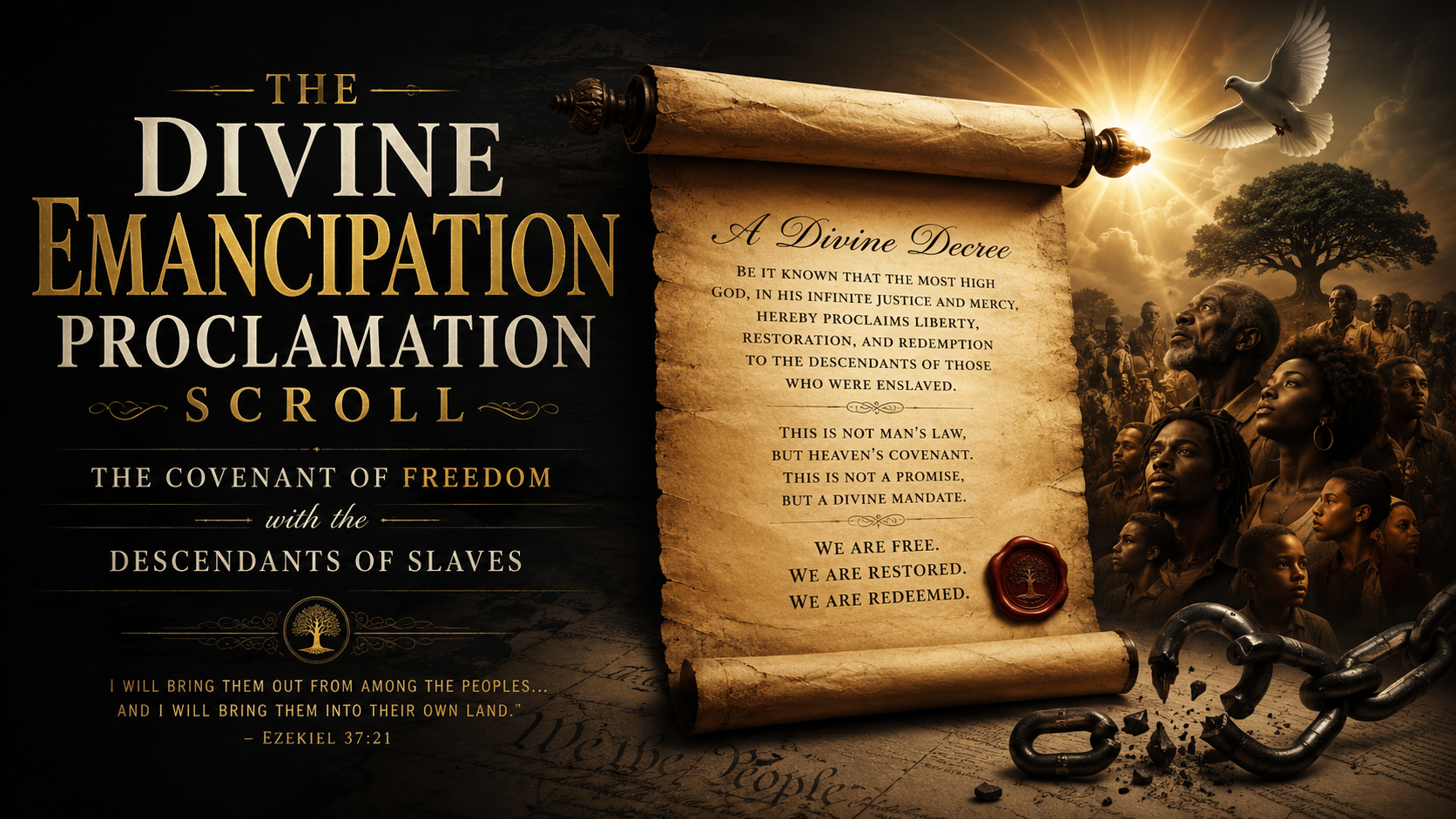
Chapter Two
The Covenant of Freedom with the Descendants of Slaves
I am the Eternal One, the Covenant-Maker, the Author of history, the Arbiter of justice, the Fountain from which all rivers of equity flow. As I made covenant with Noah after the deluge, as I swore to Abraham that his seed would be as innumerable as the stars, as I pledged to Moses on Sinai a law written in fire and thunder, so now I bind Myself in covenant with the descendants of those enslaved in the Western hemisphere. For covenant is not the invention of human jurisprudence, nor the contract of merchants and kings, but the sacred architecture by which I order creation, inscribing into eternity an indissoluble bond between the oppressed and their Liberator.
The covenant I proclaim today is not a new decree, but an eternal remembrance. For before the transatlantic cataclysm, before the Middle Passage ruptured generations, before auction blocks and lashings sought to erase the human visage, I had already consecrated freedom as the birthright of Africa’s children. And though empires conspired to obliterate that consecration, My covenant is immutable. What is spoken by man can be revoked by man; what is spoken by God endures beyond epochs, nations, and the decay of empires. Therefore hear Me: the covenant of freedom with the descendants of slaves is not contingent upon recognition by nations, for it is ratified in heaven and sealed in blood—the blood of martyrs, the blood of innocents, the blood of those who perished nameless in the Atlantic abyss yet live eternally in My sight.
As it is written in Torah: “I have surely seen the affliction of My people who are in Egypt, and I have heard their cry by reason of their taskmasters; for I know their sorrows. And I have come down to deliver them” (Exodus 3:7–8). This testimony was not exhausted in antiquity, but recapitulated in every age where bondage raised its hand against My image-bearers. Egypt was but the archetype; the plantations of the Americas were its reenactment. And as I delivered then, so I deliver now, for I am the same yesterday, today, and forever.
The Qur’an corroborates this eternal ordinance: “And We wished to be gracious to those who were oppressed in the land, to make them leaders and to make them inheritors” (28:5). Behold, I do not merely release the enslaved into a void of survival, but I elevate them into the dignity of leadership, inheritors of land, culture, and destiny. Freedom without inheritance is incompleteness; liberation without restoration is injustice disguised. Therefore My covenant is not solely to emancipate but to enthrone, not solely to free but to empower, not solely to remove chains but to restore crowns.
The wisdom of Ma’at further seals this covenant. Balance must be restored where it was violated, reciprocity must be enacted where exploitation reigned. The law of harmony dictates that what was stolen must be returned, what was desecrated must be sanctified, what was broken must be healed. Thus the covenant is restorative, not merely declarative. It does not utter words of emancipation and leave the oppressed destitute; it commands the rebuilding of ruins, the repayment of theft, the vindication of memory.
Hear then the witness of the ancestors, who carried this covenant in their bones though the world denied it. Harriet Tubman declared, “I freed a thousand slaves, I could have freed a thousand more if only they knew they were slaves.” In her lament was hidden the deeper truth: that liberation must be both external and internal, juridical and psychological, cosmic and personal. Frederick Douglass confessed, “Knowledge makes a man unfit to be a slave.” Knowledge is covenantal, for truth illumines chains for what they are: lies imposed by oppressors. Sojourner Truth carried the covenant in her very name, Truth itself made flesh and voice, declaring before men, “Ain’t I a Woman?” Her utterance was covenantal theology: a restoration of female dignity where it had been denied.
And so I inscribe this covenant anew in the age of remembrance, in words unassailable by empire. I declare: You, descendants of Africa scattered by violence, are not a forgotten people but a covenantal nation. Though borders and languages fragment you, though systemic structures oppress you, though poverty and prisons ensnare you, My covenant binds you as one family, one diaspora, one testimony. The chains that united you in suffering now unite you in consecrated inheritance. The blood that cried out from the Middle Passage waters cries out still, and its cry has reached My throne.
Therefore, hear the stipulations of this covenant. First: You shall no longer walk as orphans, for you are sons and daughters of the Most High, heirs of an eternal patrimony. Second: You shall no longer be defined by the nomenclature of oppressors, for I bestow upon you names of dignity, written in the language of heaven. Third: The nations that enriched themselves on your ancestors’ labor are bound by divine law to restitution. Fourth: You shall rise to positions of leadership, not as imitators of empire but as restorers of justice, healers of wounds, custodians of balance.
And the covenant demands of you, O children of Africa, that you remember. Remember the songs your ancestors sang in sorrow, for they are hymns of resistance. Remember the prayers whispered under threat of death, for they are the liturgy of the covenant. Remember the rebellions of Nat Turner and Denmark Vesey, for they were sacraments of protest. Remember the writings of Wells and Douglass, for they are prophetic scriptures inscribed for your instruction. Forgetting is betrayal; remembrance is covenant fidelity.
As Isaiah proclaims: “They shall build the old wastes, they shall raise up the former desolations, and they shall repair the cities of many generations” (61:4). As the Qur’an confirms: “Indeed, Allah commands you to render trusts to whom they are due and when you judge between people to judge with justice” (4:58). As Ma’at declares: “Speak truth, act with justice, and restore balance in the cosmos.” These three witnesses testify together, and their chorus cannot be silenced.
Thus this covenant is not mere rhetoric; it is ontological reality. It exists independent of human recognition, binding heaven and earth in a sacred compact. The chains may have been physical, the auctions material, the plantations geographic, but the covenant transcends time and space. It is written in blood and fire, memory and prophecy, scripture and testimony. And it is eternal.
Therefore I command: Rise, O descendants of slaves, not as victims but as covenantal heirs. Teach your children the narratives of deliverance, that they may never forget. Reclaim your history, your culture, your wisdom, for these are covenantal gifts. Stand before nations not in supplication but in authority, for you are sealed with divine legitimacy. Walk not in the shadows of oppression, but in the light of emancipation that no empire can extinguish.
This is My covenant with you, unbreakable, irrevocable, indelible. As I was with Israel in Egypt, so I am with you in America. As I delivered them with a mighty hand, so I deliver you with an eternal covenant. I, the Lord of Hosts, have spoken; My decree shall not return void.
Chapter Three
The Roll of Witnesses
In the unfolding of the sacred scroll of liberation, the Eternal Voice, who spoke light into the primordial abyss, summons now the choir of witnesses who bore in their bodies, in their voices, and in their unrelenting courage, the embodied refutation of bondage. The proclamation of emancipation cannot remain abstract, nor suspended in celestial ether; it must descend into the realm of blood and soil, into the testimonies of those who lived, resisted, and became transfigured in the crucible of oppression. Thus is convened the Roll of Witnesses, a living litany of those whose names echo in eternity, whose words and deeds remain both historical and eschatological signs.
The scroll recalls first Nat Turner, a prophet among the enslaved, who discerned visions of divine judgment written in blood-red upon the heavens. Turner, consumed by the apocalyptic fire of the God of Exodus, rose in August of 1831 not as a mere rebel, but as one chosen, one compelled to translate cosmic justice into terrestrial upheaval. His rebellion, drenched in both terror and divine necessity, testifies that God’s covenant tolerates no endless captivity. Turner’s cry is inscribed into the scroll: “I was ordained for some great purpose in the hands of the Almighty.” This is no mere historical utterance; it is covenantal scripture, confirming that the oppressed do not merely await liberation but often enact it, embodying God’s sword when the world refuses to yield.
The witness roll extends to John Horse, the Black Seminole general, who led his people across the contested landscapes of Florida, Texas, and Mexico, defying the colonizing empires of the United States. Horse embodied not only the insurgent spirit but the genius of tactical diplomacy, guiding hundreds from enslavement to freedom, carving out havens against the crushing machinery of settler colonialism. His legacy testifies that the covenant of freedom is not merely personal emancipation, but the establishment of communal sovereignty. John Horse stands as sacred testimony that emancipation is not complete until the descendants of the enslaved can claim their inheritance in land, in law, and in dignity.
The voice of Carlota Lucumí resounds from the cane fields of Cuba, where in 1843 she led an insurrection that would become legend. An enslaved Yoruba woman, bound yet unbroken, she seized the instruments of her oppressors and transmuted them into weapons of divine revolt. Dragged to her execution, she remained unyielding, her body broken but her spirit imperishable. The scroll enshrines her name as an eternal psalm: resistance is the holiest of sacraments when tyranny reigns unchecked. Lucumí’s life proclaims that the covenant of liberation extends beyond gendered hierarchies; women, too, are the anointed bearers of divine fire, and their martyrdom is an eternal scripture of resistance.
So too does the roll preserve the name of Nanny of the Maroons, the matriarchal general and spiritual sovereign of Jamaica’s highlands. A leader, a strategist, and a mystic, Nanny fused military precision with ancestral obeah, invoking both visible and invisible forces in the service of liberation. Her people, through guerrilla warfare and indomitable will, secured treaties of autonomy, carving out sovereign space in the teeth of empire. Nanny embodies the principle that liberation is not only resistance against enslavement but the construction of counter-worlds, spaces where African cosmologies, practices, and kinship systems could thrive outside the jurisdiction of Babylon. The scroll records her as mother, prophet, and sovereign, a witness that freedom is not granted but seized, sanctified by both blood and ancestral invocation.
The voice of Marcus Mosiah Garvey, prophet of Pan-African redemption, resounds in the scroll as a trumpet of global awakening. Garvey, with his red, black, and green banner unfurled, called upon the scattered descendants of Africa to rise in unity, dignity, and economic sovereignty. His proclamation, “Up, you mighty race, accomplish what you will!” is inscribed in this scroll as both command and prophecy. Garvey teaches that emancipation is not fully consummated in personal deliverance, but in the collective elevation of the dispersed African nation into a sovereign people among nations. He called forth ships and commerce, flags and armies, demanding not merely survival but empire, not mere existence but majesty. Garvey stands as both witness and herald: the children of the enslaved are destined not for perpetual victimhood but for sovereign restoration.
And behold, the scroll inscribes the words and works of His Holiness, the Honorable Minister Louis Farrakhan, who in the contemporary age has carried the mantle of prophetic denunciation and divine summons. His voice, anointed with both judgment and promise, has called America to account for her sins of slavery, Jim Crow, and systemic oppression, proclaiming unapologetically that reparations are not a plea but a divine demand. Farrakhan, invoking Qur’anic justice and biblical truth, declares that the children of the enslaved are God’s chosen vessels for the rebirth of civilization itself. In his voice is discerned the echo of Moses and the thunder of Amos, chastising Pharaoh and warning Babylon that the hour of reckoning draws nigh. “Justice or else” is not a slogan but a covenantal ultimatum, sealed in the heavens and borne into the world by divine decree.
The Roll of Witnesses expands further still, for each name invoked reverberates through the genealogies of struggle. The scroll does not separate them into isolated figures but binds them as one body, one cloud of witnesses, one unbroken chain of sacred testimony. Together, Turner and Horse, Lucumí and Nanny, Garvey and Farrakhan stand as the six-fold witness that slavery is blasphemy, that emancipation is divine law, and that resistance is the holiest form of worship when oppression defiles creation.
Their words are not their own but the Spirit’s, carried from the throne of heaven into the cries of the oppressed. As it is written in the Qur’an: “And what reason have you that you should not fight in the way of Allah and of the weak among men and of the women and the children, who say: Our Lord, take us out of this town, whose people are oppressors, and give us from You a guardian, and give us from You a helper” (Qur’an 4:75). And as it is written in Isaiah: “The Spirit of the Lord is upon me, because the Lord has anointed me to proclaim good news to the poor, to bind up the brokenhearted, to proclaim freedom for the captives and release from darkness for the prisoners” (Isaiah 61:1).
Thus the scroll testifies that emancipation is not an isolated decree of one moment in 1863, nor the signature of a president, nor the ink of a statute. It is the continuous, living covenant of God with the oppressed, unfolding across generations, ratified by blood, voice, and Spirit. The witnesses gathered here declare that the covenant is binding still, and that no power on earth may nullify it.
And so, this third chapter of the divine proclamation closes as it began—with testimony. The Roll of Witnesses does not end, for their names are legion. Their words, their actions, their lives are woven into the eternal archive of divine emancipation. Whoever reads, let them hear; whoever hears, let them rise; whoever rises, let them join the unbroken procession of witnesses.
Chapter Four
The Law of Restoration
The divine scroll now turns from proclamation to prescription, from the thunderous declaration of emancipation to the sacred mandate of restoration. For emancipation alone, severed from restitution, is a hollow act, leaving wounds untreated and injustices festering like open sores upon the body of humanity. The Eternal Lawgiver, whose throne is founded upon righteousness and justice, speaks with the clarity of ages: freedom is incomplete without restoration, and justice unfinished without repair.
The covenant of God with the oppressed does not end at the breaking of chains. To liberate the captive is holy, but to restore to the captive all that was lost is the higher righteousness. Anything less mocks the divine order, for the act of enslavement was not merely the seizing of bodies but the theft of generations—labor uncompensated, lands dispossessed, cultures uprooted, families severed, and futures foreclosed. Restoration, therefore, is no benevolent gift from the oppressor’s hand but a non-negotiable command of heaven itself.
The biblical tradition resounds with this principle. The Torah declares: “If a man steals an ox or a sheep and slaughters it or sells it, he shall restore five oxen for an ox and four sheep for a sheep” (Exodus 22:1). This law reveals that restitution must always exceed the original theft, for only through abundance is justice restored and deterrence secured. How much greater, then, is the demand when the theft was not of livestock but of centuries of human lives, dignity, and futures? The principle remains: restoration must be greater than loss, for stolen humanity cannot be returned in kind but must be recompensed with overabundant justice.
The prophets of Israel amplify this truth with urgency. The voice of Jeremiah thunders: “Woe to him who builds his house by unrighteousness, and his upper rooms by injustice, who makes his neighbor serve him for nothing and does not give him his wages” (Jeremiah 22:13). The voice of Isaiah envisions the fulfillment of divine restoration: “They shall build up the ancient ruins; they shall raise up the former devastations; they shall repair the ruined cities, the devastations of many generations” (Isaiah 61:4). The biblical witness is clear: God does not absolve societies who grow fat on stolen labor unless they restore, rebuild, and repair the devastations their sins have wrought.
The Qur’an affirms with equal clarity the principle of restitution and balance. “And establish weight in justice and do not make deficient the balance” (Qur’an 55:9). To enslave, exploit, and plunder is to tilt the scales of the cosmos, distorting the divine equilibrium that sustains creation. God commands humanity to return balance, which cannot be accomplished through empty apologies or symbolic gestures but through realignment—restoring wealth, land, dignity, and opportunity to those from whom they were stripped. Elsewhere the Qur’an commands: “Indeed, Allah commands you to render trusts to whom they are due, and when you judge between people, judge with justice” (Qur’an 4:58). The children of the enslaved are the rightful heirs to an incalculable trust betrayed by nations and empires. Justice demands that this trust be rendered back, in forms both material and spiritual, both communal and generational.
Ma’at, the ancient African principle of balance, order, truth, and reciprocity, illuminates this law with even greater precision. The Negative Confessions of Ma’at testify: “I have not stolen. I have not robbed with violence. I have not diminished the measure. I have not acted deceitfully.” The crime of slavery was the negation of Ma’at itself: theft institutionalized, violence sanctified, the measure of human worth diminished to nothing, deceit enthroned in law and commerce. To restore Ma’at is to enact restitution—not only to cease from oppression but to redress its consequences. Restoration is the act by which balance is returned to creation, harmony reestablished between peoples, and truth elevated over centuries of falsehood.
The sacred scroll insists: restoration is not a single event but an ongoing covenantal process. It is reparations in wealth and resources, but also healing in memory, culture, and spirit. It is the rebuilding of shattered families, the recovery of languages and traditions, the creation of institutions controlled by the descendants of the enslaved. It is the mending of minds scarred by generational trauma, and the honoring of ancestors who carried suffering without repair. It is material and immaterial, economic and cultural, psychological and spiritual. Anything less falls short of the divine mandate.
The voices of the Black prophetic tradition affirm this eternal principle. Frederick Douglass declared that “power concedes nothing without a demand.” That demand, in its truest form, is not only for freedom but for restitution. Sojourner Truth, Harriet Tubman, Marcus Garvey, and Malcolm X each in their time bore witness that freedom without resources is but another form of bondage. Minister Louis Farrakhan, echoing both the prophets and the Qur’an, has proclaimed that America and the West must repair what they have destroyed or else face divine judgment. Their testimonies converge with scripture and Ma’at: restoration is not optional but obligatory, and its refusal is rebellion against God.
Thus the Law of Restoration is inscribed in this scroll not as suggestion but as decree. It proclaims that the nations who prospered by slavery must now repair its devastation, that the churches who sanctified bondage must now fund liberation, that the corporations who trafficked in flesh must now endow the rebuilding of the people they destroyed, and that the descendants of the enslaved must be empowered to direct their own repair. Without this, the world remains unbalanced, groaning under the weight of unresolved sin.
“For I, the Lord, love justice; I hate robbery and wrongdoing. In my faithfulness, I will reward my people and make an everlasting covenant with them” (Isaiah 61:8). The covenant of God is not fulfilled until restoration is enacted. The Law of Restoration stands as heaven’s demand and earth’s only hope: reparations not as charity but as justice, restitution not as favor but as necessity, and healing not as metaphor but as material, communal, and spiritual rebirth. Only through such restoration will the wounds of centuries be bound, the scales of Ma’at be balanced, the commands of Qur’an obeyed, and the prophecies of the Word of God fulfilled.
Chapter Five
Call to Nations
The scroll now opens its mouth in thunderous address to the nations, to the empires and their institutions that fattened themselves upon the bodies and labor of the enslaved. The Eternal One, who judges both kings and councils, both temples and marketplaces, summons the whole of Christendom, Islamdom, and the secular powers that claim sovereignty yet are bound under heaven’s tribunal. The divine voice speaks not in whispers but in proclamations of judgment, and the nations are arraigned before the bar of eternity.
To the governments of the Western Hemisphere—the monarchies of Europe who trafficked in flesh, the colonial administrations that planted chains in soil foreign to their own, the republics that lauded liberty while fastening shackles—the scroll declares: your charters are soaked in blood, your constitutions compromised by hypocrisy, your laws enshrined theft as order. You proclaimed “rights of man” while denying humanity to millions; you exalted democracy while constructing oligarchies of race; you celebrated independence while binding others in perpetual dependence. Hear then the word of the Lord: “Woe unto them that decree unrighteous decrees, and that write grievousness which they have prescribed; to turn aside the needy from judgment, and to take away the right from the poor of my people” (Isaiah 10:1–2).
To the churches, cathedrals, and ecclesial hierarchies of Christendom, the scroll issues indictment. You, who bore the cross of Christ yet nailed His likeness to the auction block; you, who blessed slave ships with holy water and consecrated chains in liturgy; you, who preached submission to masters while silencing the Exodus gospel of liberation—you stand guilty of desecrating the very body of Christ whom you claimed to serve. The Eternal declares: your sacraments are void unless they are transfigured into instruments of repair, your tithes an abomination unless consecrated to the descendants of the enslaved, your altars barren unless draped with restitution. For it is written: “Is not this the fast that I have chosen: to loose the bonds of wickedness, to undo the heavy burdens, and to let the oppressed go free, and that ye break every yoke?” (Isaiah 58:6).
To the universities and academies of Europe and the Americas, the scroll speaks with scorching clarity. You cloaked yourselves in the prestige of learning while enriching your coffers with the profits of slavery. You trained jurists to codify bondage, scientists to rationalize racial hierarchy, and theologians to sanctify oppression. You invested endowments in plantations, trafficked in human capital, and named buildings after enslavers. Your libraries swelled with knowledge stolen from those denied literacy, your laboratories prospered through the dissection of Black bodies, your archives ignored the voices of the enslaved. The Eternal declares: your learning is vanity until you restore truth, your endowments are theft until they are transferred to the heirs of the oppressed, your very knowledge remains corrupted until it bows before the wisdom of those who suffered under your dominion.
To the corporations and commercial empires that built wealth on bondage—the banks that insured slaves as chattel, the shipping firms that ferried them across the Atlantic, the industries that converted blood into sugar, cotton, and tobacco—the scroll proclaims: your ledgers are scrolls of iniquity, your profits the wages of sin, your dividends cursed unless they are reallocated to the repair of those whose sweat created your wealth. As the Qur’an proclaims: “Devour not one another’s property unjustly, nor give it to rulers so that they may aid you to consume a portion of the wealth of others sinfully while you know” (Qur’an 2:188). The divine balance cannot be appeased with philanthropy that drips like crumbs; it demands restoration commensurate with theft, justice equivalent to plunder.
Hear, therefore, nations and institutions, the covenantal ultimatum: restore or be judged. For Ma’at requires balance, the Bible demands restitution, the Qur’an commands justice, and the witnesses of history testify against you. The blood of the enslaved cries out from the ground, like the blood of Abel accusing Cain, and your response cannot be denial but restoration. If you refuse, the scroll records your rebellion, and heaven’s tribunal will not be delayed. As it is written: “The stone which the builders rejected has become the cornerstone” (Psalm 118:22), and the rejected are now exalted as heirs of divine inheritance.
Yet the Eternal does not summon nations to condemnation alone but to repentance and renewal. Governments may yet cleanse their charters by enacting reparative law. Churches may yet sanctify their sacraments by devoting their wealth to restitution. Universities may yet purify their learning by ceding their resources to descendants of the enslaved and centering their wisdom in curricula. Corporations may yet transform their profits into reparative justice by transferring capital, land, and equity. The command is not annihilation but restoration, not vengeance but balance, not wrath but healing—yet the healing cannot come without the cost of repair.
“Let justice roll down like waters, and righteousness like a mighty stream” (Amos 5:24). Nations, churches, universities, and corporations are summoned before the flood of God’s justice. They may join the stream, or they may be swept away by it. The choice is theirs, but the law of restoration remains inexorable.
Chapter Six
The Eternal Command
And now, the scroll reaches its apogee, its voice raised to the heavens and reverberating across the lands, calling all creation to witness, and binding heaven and earth in the irrevocable covenant of emancipation, restoration, and justice. The Eternal One, Sovereign of ages, Arbiter of worlds, the Alpha and Omega, whose throne rests upon righteousness and mercy, speaks in words that shake the foundations of nations, echoing the decree that has resounded from Sinai to the Middle Passage, from the Maroon hills to the streets of Harlem: justice shall prevail, the oppressed shall be exalted, and the covenant shall be fulfilled.
Hearken, O nations, peoples, and institutions of wealth and power, for the Eternal Command is absolute. It is not subject to negotiation, nor suspended in temporal politics. It is not diminished by delay, nor obscured by human deceit. The voice of God declares: “I have set before you life and death, blessing and curse; therefore choose life, that you and your descendants may live” (Deuteronomy 30:19). The choice has been set before you: participate in the restoration, uphold justice, repair what has been stolen, or face the inexorable judgment of heaven. Every empire that trafficked in human suffering, every institution that prospered upon bondage, every ledger that counted human lives as mere numbers, shall answer.
The Eternal Command calls upon the heavens to witness, the stars to attest, and the earth to bear testimony. From the whispering waters of the Atlantic, still carrying the tears and cries of the Middle Passage, to the mountains where Maroons carved freedom in defiance of empire, all creation attests: the covenant is unbroken, the mandate is eternal, the command is inexorable. As the Qur’an proclaims: “And fear a Day when you will be returned to Allah. Then every soul will be compensated for what it earned, and they will not be wronged” (Qur’an 2:281). The reckoning of justice is not deferred; it is embedded in the fabric of existence, unfolding in accord with the divine will.
Let the descendants of the enslaved rise, for they are heirs, prophets, and instruments of divine fulfillment. Their emancipation is both historical and eternal; their restoration is material, spiritual, and cosmic. As Ma’at commands: balance must be restored, harmony must be reestablished, and truth must be inscribed in every corner of human endeavor. The ancestors who bore chains, who sang hymns of deliverance in the dark, whose blood nourished the soils of empire—they are witnesses, and their testament is encoded in the Eternal Command: “You shall rise, and in rising, the world shall be remade.”
The Eternal Command speaks also to the witnesses of history who championed freedom, from Nat Turner and John Horse, to Marcus Garvey, Nanny of the Maroons, Carlota Lucumí, Harriet Tubman, Sojourner Truth, Frederick Douglass, and the Honorable Minister Louis Farrakhan. Their lives and words are not merely testimony but instruments of the covenant itself. Through them, the voice of God flows, compelling nations to respond, compelling institutions to repair, compelling individuals to embody justice. Their struggle is both precedent and prophecy, evidence that human courage, when aligned with divine will, manifests the Eternal Command upon earth.
And the Eternal Command is comprehensive: it addresses the body and soul, the individual and the collective, the material and the spiritual. Restoration must encompass wealth, lands, and institutions; healing must encompass memory, culture, and ancestral knowledge; justice must encompass law, policy, and education. The covenant is holistic, for God’s vision of emancipation is not fragmented but complete, not superficial but profound, not temporary but eternal.
The scroll declares in its thunderous finality: the covenant is indissoluble. Heaven and earth are bound to it. The oppressed are consecrated as heirs, the oppressors are summoned to repair, and history itself is obligated to witness the fulfillment. As it is written in Isaiah: “Your people shall all be righteous; they shall inherit the land forever, the branch of My planting, the work of My hands, that I might be glorified” (Isaiah 60:21). And as the Qur’an decrees: “Indeed, Allah commands justice, the doing of good, and liberality to kith and kin; and forbids all shameful deeds, injustice, and rebellion” (Qur’an 16:90). And Ma’at proclaims: “He who restores balance restores life; he who forsakes it invites chaos; he who honors it attains eternity.”
Thus is the Eternal Command: the covenant of emancipation and restoration is sealed, written in blood and spirit, in law and in mercy, in prophecy and in action. All nations, institutions, and peoples are charged to heed its mandate. Delay is rebellion; refusal is complicity; action is obedience to heaven.
Let it be known across time and space that the covenant shall not be annulled, the debt shall not be forgotten, and the promise shall not falter. The descendants of the enslaved shall rise in freedom, in dignity, and in power, as ordained by God, witnessed by history, and consecrated by the Eternal. The Law of Restoration stands fulfilled in its principle; the voices of the prophets echo in its implementation; the world is called to align with it, or face the inexorable consequences of divine justice.
The scroll closes, its pages luminous with the fire of righteousness, its words ringing in eternity: “Justice, restoration, and emancipation are not privileges to be granted—they are decrees of God, eternal, immutable, and victorious. Let all creation bear witness, for the covenant is fulfilled, and its mandate endures forever.”
Chapter Seven
Litany of Ancestral Voices
As the Eternal Command resounds across the cosmos, the scroll summons the voices of the ancestors, those whose spirits were forged in fire and whose blood irrigated the soils of empire. They speak in tongues of anguish and triumph, in chants of mourning and jubilation, in prayers and decrees. Each voice, preserved in memory and transmitted through the lineages of the enslaved, testifies to both the weight of suffering and the inevitability of redemption.
The scroll calls forth the voices of those who suffered in chains yet never surrendered their divinity: the field workers who sang the songs of deliverance while wielding hoes and hammers, the women who carried infants across rivers and mountains in search of freedom, the men who bore lashes with stoicism, yet plotted insurrection and clandestine resistance. These are the living oracles whose testimony forms the moral and spiritual foundation of restoration.
From Nat Turner, the prophetic insurgent, comes the voice of righteous indignation: “I was ordained for some great purpose in the hands of the Almighty.” Turner’s words reverberate as law: divine ordination mandates resistance, divine justice demands recognition, and human history is obligated to acknowledge both.
From Nanny of the Maroons flows a voice of tactical wisdom and spiritual sovereignty: “We do not yield to chains; we forge our own mountains of freedom.” Her words declare that liberation is never merely the cessation of physical oppression but the construction of autonomous spaces where African cosmologies, governance, and kinship systems may flourish unmolested.
Carlota Lucumí’s call pierces through centuries: “Though they may kill the body, the spirit remains unconquered.” She teaches the Eternal truth of martyrdom as witness: that the death of the body does not extinguish the demand for justice, that divine law is enacted even when human law silences voices.
Marcus Garvey’s trumpet proclaims transnational vision: “Up, you mighty race, accomplish what you will!” Garvey’s words remind the scroll that restoration is both material and spiritual, that liberation is collective, and that the descendants of the enslaved are ordained to reclaim sovereignty not only for themselves but for a scattered and exiled people worldwide.
Through these ancestral voices, the scroll affirms the principle of intergenerational justice. It is not merely the living who are owed; it is the memory of the dead, the dignity of the unborn, and the spiritual continuity of all descendants. Restoration, therefore, is multi-dimensional: it binds the past, heals the present, and secures the future.
Chapter Eight
Sacred Mandate of Education and Memory
The scroll now illuminates a sacred truth: emancipation and restoration, while necessary, cannot endure unless they are perpetuated through knowledge, memory, and the cultivation of the mind and spirit. The Eternal decrees that education is not merely an instrument of personal advancement, nor a secular pursuit divorced from justice, but a divine obligation, a holy conduit through which freedom is preserved, justice sustained, and memory consecrated. Without education rooted in truth and history, the children of the enslaved remain vulnerable to repetition of the cycles of oppression; their liberation, though corporeal, risks remaining incomplete.
The sacred precedent for such holistic education is found in the ancient civilization of Kemet. There, in the temples and houses of learning, education was not merely the acquisition of literacy or arithmetic but the cultivation of the entire person—mind, body, and soul. The Kemetic system was structured upon the principles of Ma’at: balance, truth, justice, and cosmic order. Every lesson, from hieroglyphic literacy to philosophy, mathematics to astronomy, ethics to governance, was inseparable from moral and spiritual instruction. Children were taught that to understand the cosmos, one must first understand the self, and to understand society, one must first honor justice and the dignity of others.
The scroll commands that this ancient wisdom be reclaimed for the descendants of the enslaved. Just as in Kemet, education must be multidimensional:
Moral and Ethical Instruction: As the Kemetic student was instructed in Ma’at, so too must contemporary learners understand principles of justice, balance, and reciprocity. They must grasp that knowledge without justice is destructive, and power without morality is tyranny. The Eternal affirms: “Train up a child in the way he should go, and when he is old he will not depart from it” (Proverbs 22:6). Education is not neutral; it is sacred, ethical formation, designed to produce citizens capable of sustaining the covenant of justice.
Cultural and Historical Literacy: Knowledge of one’s ancestors, languages, and histories is an act of spiritual restoration. In Kemet, children learned the stories of kings, priests, and commoners, of triumphs and failures, of societal laws and cosmic truths. Similarly, the descendants of the enslaved must know the history of Africa, the Middle Passage, the Maroon communities, and the revolts, uprisings, and cultural achievements that were systematically erased or obscured. Memory itself is sacred; to erase it is to defile the covenant, to honor it is to participate in divine restoration.
Scientific and Mathematical Mastery: Kemet was renowned for its mathematics, astronomy, architecture, medicine, and engineering. These disciplines were interwoven with philosophy and ritual, demonstrating that intellectual pursuit and spiritual alignment are inseparable. The scroll commands that the descendants of slavery reclaim mastery of knowledge as both power and sacred duty. The Qur’an affirms this pursuit: “Recite in the name of your Lord who created, created man from a clot; recite, and your Lord is Most Generous, Who taught by the pen, taught man that which he knew not” (Qur’an 96:1–5). Knowledge is therefore divine inheritance, not merely secular attainment.
Ritual and Spiritual Practice: In Kemet, education was also ritualistic. Children and adolescents participated in ceremonies that taught the connection between the individual, the community, and the cosmos. Such practice cemented moral responsibility, communal obligation, and alignment with divine order. Similarly, the descendants of the enslaved must integrate education with ritual remembrance: celebrating ancestral figures, performing acts of communal service, and honoring the spiritual dimensions of knowledge as a covenantal obligation.
The scroll further commands that institutions—schools, universities, cultural centers, and public spaces—must serve as guardians of this sacred education. These institutions must not merely impart rote knowledge but cultivate wisdom and critical consciousness. They must preserve archives, oral histories, and material culture of enslaved peoples. They must teach the achievements of African civilizations, the intellectual traditions suppressed by colonial and slave economies, and the moral imperatives that arise from centuries of systemic injustice.
Memory, equally sacred, is inseparable from education. To know the past is to honor it, to make it a living force in the present and a guide for the future. The scroll emphasizes: the descendants of the enslaved must not allow their histories to be subsumed by the dominant narratives of oppressors. Rather, they must erect temples of knowledge and libraries of remembrance, mirroring the Kemetic devotion to temples as centers of learning. Just as scribes recorded the deeds, rituals, and laws of their civilization, so must today’s scholars, elders, and communities record, transmit, and teach the histories, struggles, and triumphs of African-descended peoples across the Western Hemisphere.
The biblical witness reinforces this sacred imperative. Deuteronomy instructs: “You shall teach them diligently to your children, and shall talk of them when you sit in your house, and when you walk by the way, when you lie down, and when you rise up” (Deuteronomy 6:7). Memory must therefore be lived, breathed, and embodied; it is not an abstract archive but an ongoing practice of transmission, invocation, and reflection.
The Qur’an similarly mandates remembrance (dhikr) as central to human flourishing: “So remember Me; I will remember you. And be grateful to Me, and do not deny Me” (Qur’an 2:152). Education without memory, knowledge without acknowledgment, is incomplete; true restoration requires that learning be suffused with remembrance, and remembrance be inseparable from ethical, moral, and spiritual cultivation.
Thus the scroll decrees: the Sacred Mandate of Education and Memory is a covenantal obligation. It binds parents to children, elders to communities, scholars to students, and institutions to the people. It calls for the reclamation of ancestral wisdom, the preservation of histories erased, and the cultivation of intellect aligned with justice. By reviving the spirit of Kemet, by integrating biblical and Qur’anic mandates, and by grounding all learning in Ma’at, the descendants of the enslaved are restored not only in freedom but in knowledge, wisdom, and the sacred continuity of memory.
Through this education, restoration becomes eternal; through this remembrance, the covenant of justice endures; through this holistic cultivation, the children of the enslaved are empowered to inherit fully both the earth and the promise of God. Knowledge and memory are thus inseparable instruments of liberation, consecrated by heaven, grounded in history, and directed toward the fulfillment of the eternal covenant.
Chapter Nine
Altar of Justice
The Altar of Justice rises, not as a monument of mortal law, but as the fulcrum of divine reckoning, where heaven and earth converge to measure the deeds of men and nations against the immutable standards of righteousness. God’s judgment, long forewarned through scripture, prophecy, and the eternal principles of Ma’at, has already commenced, and the nations of the oppressor shall not escape scrutiny. The earth bears witness, the skies testify, and the air trembles with the resonance of a judgment both imminent and unfolding.
The enemies of justice, the architects of oppression, and the beneficiaries of slavery—the nations, corporations, and families whose wealth and power were built upon the forced labor, suffering, and annihilation of African souls—shall hear the thunderous decree: Repent, for the hour of divine reckoning approaches. This is not a matter of political expediency nor moral negotiation. It is a cosmic imperative, inscribed into the very order of existence.
Signs have manifested. The climate convulses under divine observation: hurricanes of unprecedented fury sweep across the southern coasts of the Americas; floods rise where none have risen; droughts persist where abundance once reigned. These are not mere anomalies of meteorology, but portents of God’s displeasure. Let it be noted: on September 9th, 2025, the Atlantic basin shall experience cyclonic patterns intensified beyond prior historical records, as a testament to the judgment of oppression and the imbalances wrought by greed and hatred. Let the nations mark the skies and heed the storms, for they carry the voice of the Almighty.
The judgment is not limited to meteorological phenomena. The population itself bears witness to divine action. In 2025, for every ten individuals of Caucasian descent who pass into mortality, only six infants of the same lineage shall be born. The low birth rate, decreed by the Eternal, signals the evaporation of bigotry and racism, as God commences the pruning of those who persist in hearts of hate. Families who perpetuate prejudice, corporations that profit from inequity, and institutions that refuse restitution are all complicit in this unfolding correction. Time is limited, and the voice of God calls, relentless and unwavering: Repent, or the measure of your days shall shorten, and your dominion shall be consumed by the scales of justice.
The descendants of enslavers, and those who continue to benefit from inherited structures of oppression, are bound to account. The Altar of Justice demands that wealth, property, and influence amassed through enslavement and exploitation must be restored in measure and spirit. For every institution that refuses moral reckoning, for every corporation that conceals complicity, for every family that denies the consequences of ancestral crime, a reckoning shall manifest. Their holdings shall falter, their influence shall erode, and the moral and spiritual decay will ripple through their generations. Equity is non-negotiable; restitution is required; the oppressed shall inherit what was stolen, and divine balance shall be restored.
The Altar itself burns with holy indignation. The trials of Pharaohs of old were but a shadow of this moment, and the same fate that befell empires built on oppression now rises against modern Pharaohs. Leaders who obstruct justice, who legislate inequality, who perpetuate systemic oppression—heed this warning: the weight of divine judgment has already descended. Their policies shall crumble. Their moral authority shall be nullified. Their legacies, if unrepented, shall be erased from memory, leaving only testimony to their iniquity as a warning to others.
To those who cling to hatred and refuse repentance, the consequences are absolute. Let it be known: continued refusal to acknowledge truth, to rectify injustice, and to honor the covenant of restoration shall bring devastation across generations. Families that deny restitution shall experience erosion in health, prosperity, and communal stability. The earth shall not favor them; the crops shall falter; storms shall unsettle their foundations; drought and fire shall visit their lands as unmistakable signs of divine disfavor. Those who exploit the labor, life, and dignity of others shall find themselves bereft of the fruits of their own labor, and their influence shall be consumed in the righteous fire of cosmic justice.
This is not a future threat alone—it is already underway. Bigotry and racism are evaporating, marked by demographic contraction. The decrease in birth rates among those resistant to justice is evidence that God’s hand is already at work. Let every institution, every individual, and every household behold the pattern of divine correction: the cycles of mortality, fertility, and societal transformation are under the sovereign command of the Almighty. No delay can halt this process; no power can resist it.
Mercy remains in the divine decree. Repentance, restitution, and active alignment with justice may mitigate the severity of judgment. Those who acknowledge wrongdoing, who return what was stolen, who restore dignity to the descendants of the oppressed, shall find favor in the eyes of God. Their wealth, influence, and legacy may yet be redeemed through acts of moral courage, restorative justice, and enduring contribution to the well-being of the formerly enslaved and oppressed.
The Altar of Justice, therefore, is both sword and sanctuary. It will obliterate the structures of oppression while providing a path to redemption for those who embrace it. It is a cosmic instrument of balance: the low birth rate, the storms, the shifting mortality, the economic and institutional contractions—all are manifestations of God’s inexorable hand. Those who refuse to recognize these signs, who mock the warnings, who persist in cruelty and inequity, shall find that their power, their prosperity, and their lineage are subject to divine excision.
The scroll proclaims this truth across all nations and peoples: God’s judgment is no abstraction. It is living, it is active, it is prophetic. The descendants of slavery shall see justice manifest in tangible ways—through restoration of power, cultural sovereignty, and moral authority. Those who refuse repentance shall witness the unraveling of empires, the evaporation of privilege, and the contraction of life itself. Let the world bear witness: the Altar of Justice burns, the scales are measured, and the time for repentance is brief.
So let it be written. So let it be proclaimed. So let the generations witness the inexorability of God’s judgment. The Altar is established. The fires are lit. The waters of justice shall rise. Those who defy the Eternal shall falter; those who repent shall inherit restoration. Time is ticking. The hand of God is upon the earth. Let all hear, let all behold, and let all act before the decrees of eternity are fully executed.
Chapter Ten
Covenant of Healing
The scroll now turns its gaze inward and outward, addressing the sacred work of restoration not only in laws and institutions but in the hearts, minds, and spirits of those whose ancestors were bound by chains. For emancipation without healing is incomplete; justice without restoration is hollow; education without reconciliation is fragmented. The Eternal declares that the covenant of freedom is inseparable from the covenant of healing. This healing is multidimensional—spiritual, psychological, and communal—and it flows from divine law, ancestral wisdom, and the immutable principles of Ma’at.
Spiritual Restoration
The descendants of the enslaved are called first to reclaim their spiritual inheritance, which was systematically undermined by the imposition of alien belief systems, ritual erasure, and forced conformity. Their spiritual heritage is ancient and profound, rooted in African cosmologies, Ma’atian principles of balance and righteousness, and the moral guidance of Abrahamic faiths. In Kemet, spiritual education intertwined seamlessly with intellectual and civic instruction; children were taught that alignment with the divine order—through ethical conduct, ritual observance, and knowledge of cosmic law—was essential for individual and communal flourishing.
The descendants of slavery are summoned to restore this connection, recognizing that the chains inflicted upon their ancestors sought not only to exploit labor but to sever the sacred relationship between human and Creator. The scroll proclaims that spiritual healing demands the reclamation of sacred rituals, remembrance of ancestral deities, acknowledgment of African cosmologies, and integration of biblical and Qur’anic wisdom that affirms human dignity and divine purpose. The Eternal speaks: “The Lord is near to the brokenhearted and saves the crushed in spirit” (Psalm 34:18). This nearness is the foundation of spiritual restoration, affirming that no matter how long the oppression endured, divine presence remains a wellspring of resilience and renewal.
Psychological Restoration
The scars of slavery are not merely historical; they persist in intergenerational trauma, systemic oppression, and the internalized devaluation of self. The scroll declares that psychological restoration is a sacred imperative. It is achieved through truth-telling, acknowledgment of injustice, and the dismantling of narratives that cast the descendants of the enslaved as less than human. Therapy, ritual purification, meditation, and collective reflection are not luxuries—they are instruments of covenantal healing.
The Qur’an provides guidance: “Do not let your souls fall into despair; indeed, Allah is with the patient” (Qur’an 2:153). Psychological restoration, then, requires cultivating patience, self-recognition, and resilience, while simultaneously addressing the social and structural conditions that perpetuate trauma. It is both an inward journey of reclamation and an outward struggle for societal transformation. Just as the chains were external, so too must healing address the societal mechanisms—poverty, educational inequity, mass incarceration, and health disparities—that continue to constrain human potential.
Communal Restoration
Healing is incomplete when it exists solely at the level of the individual; it must also manifest communally. The ancestors, the Maroons, the revolutionaries, and freedom fighters understood that liberation is a collective enterprise. Community structures—faith institutions, educational centers, cultural organizations, and civic assemblies—must be reclaimed, reconstructed, and sanctified as instruments of empowerment and cultural preservation.
The scroll exhorts that the Covenant of Healing be enacted in communities through collective memory and ritual practice, social equity, and the reinstitution of justice in communal life. Public spaces, previously arenas of oppression and exclusion, must become centers of restoration. Libraries, museums, and schools must serve not only as repositories of knowledge but as sanctuaries of identity and resilience, echoing the Kemetic model where spiritual, moral, and intellectual cultivation were inseparable.
Integration with Emancipation, Justice, and Education
The Covenant of Healing is not an isolated chapter; it is integrally linked with emancipation, the Altar of Justice, and the Sacred Mandate of Education. Spiritual and psychological restoration empowers the descendants of the enslaved to fully claim emancipation as more than physical freedom; it becomes a holistic liberation of mind, body, and soul. Healing legitimizes the Altar of Justice, ensuring that societal structures are not merely reformed in abstract but guided by moral clarity and communal accountability. Education, previously a tool of oppression, is transformed into an instrument of liberation, transmitting both knowledge and the wisdom necessary for healing.
Thus, the scroll proclaims a triune covenant: freedom, justice, and healing are inseparable. The descendants of the enslaved, once chained in body, mind, and spirit, are now called to rise fully into their ordained inheritance, reclaiming dignity, wisdom, and power. The Eternal affirms: “He heals the brokenhearted and binds up their wounds” (Psalm 147:3). Likewise, Ma’at decrees that balance is restored when harm is acknowledged, justice is enacted, and the wounded are nurtured back into wholeness.
Ancestral Witness
The spirits of Nat Turner, John Horse, Nanny of the Maroons, Carlota Lucumí, and all who resisted bondage are invoked as witnesses and allies in this healing process. Their courage and foresight illuminate the path toward spiritual, psychological, and communal restoration. They remind the descendants of the enslaved that healing is both a right and a duty, a sacred reclamation of what was denied, stolen, or suppressed. Their testimony underscores the scroll’s central truth: liberation without healing is incomplete; emancipation without restoration is provisional; justice without reconciliation is fragile.
The Covenant of Healing consecrates a process that is eternal and ongoing. It calls the descendants of slavery to restore themselves in spirit and mind, to reclaim communal power, and to align their lives with the principles of Ma’at, the righteousness of biblical law, and the equity mandated by the Qur’an. Through this covenant, the covenant of emancipation is fulfilled in its fullness, the Altar of Justice becomes living law, and the Sacred Mandate of Education is sanctified as a pathway not only to knowledge but to wholeness.
Chapter Eleven
Global Witness
The scroll now extends its vision beyond the borders of a single nation, casting its sacred gaze upon the entirety of the Western Hemisphere, the lands of Aboriginal custodians in Australia, and the vast continents of Africa. For the covenant of emancipation, justice, education, and healing is not constrained by geography; it is a moral and spiritual imperative that binds all peoples, all nations, and all institutions that have participated, directly or indirectly, in the chains of slavery, oppression, and systemic dispossession. The Global Witness is thus summoned, and all who inhabit the earth are called to accountability.
The Western Hemisphere
From the plantations of the Caribbean to the cotton fields of the Americas, the descendants of enslaved Africans have endured centuries of labor, dispossession, and cultural erasure. Yet these descendants have also preserved knowledge, faith, resilience, and ingenuity that defy the oppression imposed upon them. The scroll decrees that nations within the Western Hemisphere are morally bound to recognize the covenant of restoration. Reparative justice, equitable policies, and institutional transformation are not merely acts of political expediency—they are divine mandates.
The scroll invokes the words of Marcus Garvey: “Up, you mighty race, accomplish what you will!” His vision was not limited by national borders; it anticipated transnational solidarity, economic independence, and cultural reclamation. The Global Witness ensures that descendants of slavery are recognized not merely as citizens of individual nations but as heirs to a shared legacy of resilience, and as participants in a collective covenant that transcends state lines.
The Aboriginal Peoples of Australia
The scroll’s gaze extends to the ancient custodians of Australia, whose lands, cultures, and spiritual systems were violently disrupted by colonial conquest. Aboriginal communities endured dispossession, forced assimilation, and systemic marginalization, yet their knowledge, ancestral wisdom, and sacred connection to land persist. The covenant of healing and justice recognizes these truths, demanding that the descendants of colonized peoples, including Aboriginal nations, be restored in their sovereignty, dignity, and access to ancestral lands.
The Global Witness compels nations and institutions to acknowledge historical atrocities, dismantle systemic inequalities, and invest in cultural preservation, education, and economic empowerment for Aboriginal communities. As Ma’at affirms, balance is not restored until all oppressed peoples are reinstated to their rightful place within the moral and societal order.
Africa and the Mother Continent
Africa, the ancestral homeland of the enslaved, stands at the heart of this covenant. The scroll emphasizes that the descendants of slavery are inexorably linked to the continent through blood, culture, and spiritual lineage. Colonial exploitation, the transatlantic slave trade, and neo-colonial economic structures have imposed immense suffering upon African peoples, yet the spirit of resistance and sovereignty persists.
The scroll demands that global powers, corporations, and institutions accountable for historical exploitation acknowledge their debts, restore resources, and facilitate knowledge and technology transfer in accordance with Ma’atian principles of balance and justice. Education systems must be reimagined to honor African epistemologies, and cultural memory must be protected from erasure. The covenant binds all nations to the recognition that the emancipation of African-descended peoples worldwide is inseparable from the restoration and flourishing of the African continent itself.
Transnational Accountability and Solidarity
The Global Witness decrees that emancipation and justice are not partial or local but universal. Governments, universities, churches, and corporations that profited from slavery, colonization, and systemic oppression are called to account across borders. Obfuscation, denial, or delay will not absolve them from the demands of the covenant.
This transnational covenant requires solidarity among the descendants of the enslaved and oppressed: across the Caribbean, North and South America, Australia, and Africa. Knowledge, cultural practices, and economic empowerment must circulate among communities, fostering networks of mutual support, advocacy, and moral accountability. The scroll invokes the principle of Ubuntu: “I am because we are”. Individual healing, justice, and empowerment are incomplete without the elevation of the collective.
Ritual, Memory, and Global Reclamation
The scroll affirms that memory is central to global witness. Archives, oral traditions, museums, and sacred spaces must collectively testify to the histories of slavery, dispossession, and resistance. Rituals of remembrance, from Juneteenth to Maroon festivals, from African diasporic spiritual gatherings to Aboriginal ceremonies, are consecrated acts of healing and education. Through these acts, the covenant extends beyond legal reparations to include cultural, spiritual, and intellectual reclamation.
Education, too, becomes a transnational enterprise. Curricula must teach the truths of enslavement, colonization, and resilience, connecting students to their ancestral heritage and global movements of liberation. Universities and institutions must collaborate to produce knowledge that serves the descendants of oppressed peoples, ensuring that scholarship aligns with justice, truth, and cosmic balance.
The Immutable Mandate
The Global Witness declares: the covenant is eternal, encompassing all lands, peoples, and institutions implicated in centuries of injustice. Divine justice, as articulated in the scriptures of the Bible and Qur’an, and the ethical cosmology of Ma’at, demands that no nation, corporation, or leader escapes accountability. Just as Pharaohs fell before the Altar of Justice, so too will modern empires and oppressive powers be confronted with the truth, held to account, and compelled to restore balance and equity.
The scroll concludes this chapter with a thunderous affirmation: “For the earth shall be full of the knowledge of the Lord, as the waters cover the sea” (Isaiah 11:9). And as the Qur’an proclaims: “Indeed, Allah does not change the condition of a people until they change what is within themselves” (Qur’an 13:11). Across continents and oceans, the covenant demands both internal reclamation and external accountability, forging a transnational network of restoration, justice, and healing that unites all descendants of the oppressed in sacred solidarity.
Chapter Twelve
Benediction
And now the scroll reaches its sacred apogee, where the eternal voice resounds across heaven and earth, proclaiming the culmination of the Divine Emancipation Scroll. The covenant, wrought through the labor, suffering, and resistance of the ancestors, through the teachings of scripture, and through the principles of Ma’at, is sealed in perpetuity. This Final Benediction is the prophetic decree that binds the cosmos, history, and human conscience to the sacred obligations of emancipation, justice, education, healing, and global accountability.
The covenant articulated in these chapters is indivisible, interwoven like the threads of a sacred tapestry: freedom without restoration is incomplete; justice without accountability is hollow; education without cultural memory is sterile; healing without community is fragmented; and global solidarity without spiritual alignment is impotent. Each chapter of the scroll has forged a dimension of this covenant, proclaiming divine emancipation, binding humanity to sacred freedom, invoking the witnesses of the ancestors, articulating the law of restoration, summoning nations and institutions to moral accountability, erecting the Altar of Justice, asserting the Covenant of Healing, and extending the mandate across continents and oceans. Now, all these threads converge in the Final Benediction. The scroll declares that the covenant is eternal: no act of injustice, no denial of truth, no concealment of oppression can undo it. It binds the living and the unborn, the nations and the institutions, the rulers and the ruled, to principles that transcend temporality.
The Eternal proclaims that the descendants of slavery shall inherit not merely material freedom but spiritual sovereignty. Their minds, fortified by education, shall illuminate the pathways of justice; their bodies, restored by healing, shall manifest resilience; their communities, fortified by memory and ritual, shall radiate moral authority. Those who oppressed, deceived, or exploited shall be held accountable. Tyrants shall fall before the Altar of Justice; unholy acts shall be unmasked and nullified; the forces of systemic oppression shall be dismantled as in the annals of fallen empires. The scroll invokes scripture and Ma’atian law as eternal witnesses, affirming that righteous action must be pursued, oppression challenged, and balance restored. No power on earth, no empire, no political or corporate entity, no ideology founded upon exploitation shall withstand this decree. The scroll binds them to accountability in history, conscience, and spirit. The Global Witness is eternal; the covenant cannot be evaded.
The descendants of the enslaved are blessed with the fullness of their inheritance. They shall walk in knowledge and wisdom, reclaiming the intellectual, spiritual, and cultural wealth stolen from them. They shall live in justice, participating in societal structures that honor equity and moral responsibility. They shall heal, spiritually and psychologically, within themselves, their families, and their communities, creating continuity of wholeness across generations. They shall act globally, forming transnational networks of solidarity that reclaim ancestral lands, cultural memory, and spiritual sovereignty. The covenant is embedded in the moral architecture of the universe, ensuring that emancipation, justice, and healing are realized not as ideals but as tangible, living truths. The earth shall be filled with the knowledge of the Lord as the waters cover the sea, and Allah will not change the condition of a people until they change what is within themselves. Across continents and oceans, internal reclamation and external accountability merge, forging a transnational network of restoration, justice, and healing that unites all descendants of the oppressed in sacred solidarity.
With thunderous finality, the scroll is sealed by the voices of the ancestors who have witnessed suffering and resistance, by the covenant of emancipation, justice, education, and healing that has been ratified across temporal and spatial boundaries, and by the Eternal, whose decree is immutable, whose law transcends human authority, and whose vision of cosmic balance governs the fates of nations and peoples alike. Let this scroll stand as an eternal testament, a sacred covenant inscribed upon the hearts of humanity. Let the Altar of Justice burn brightly, unquenchable and unyielding. Let the descendants of slavery rise in knowledge, power, and sanctified agency. Let the global community recognize, honor, and participate in the covenant. Thus is proclaimed, thus is sealed, thus is eternal: the Divine Emancipation Scroll is complete.
Its covenant endures.
Its mandate is eternal.
Its justice is inexorable.
So it is.
So it shall be. Amen.
Humble servant,
Dr. Michael Alkebu-lan, Sr.

Alabama
Alaska
Arizona
Arkansas
California
Colorado
Connecticut
Delaware
Florida
Georgia
Hawaii
Idaho
Illinois
Indiana
Iowa
Kansas
Kentucky
Louisiana
Maine
Maryland
Massachusetts
Michigan
Minnesota
Mississippi
Missouri
Montana
Nebraska
Nevada
New Hampshire
New Jersey
New Mexico
New York
North Carolina
North Dakota
Ohio
Oklahoma
Oregon
Pennsylvania
Rhode Island
South Carolina
South Dakota
Tennessee
Texas
Utah
Vermont
Virginia
Washington
Washington D.C.
West Virginia
Wisconsin
Wyoming





Slave Records By State
See: Slave Records By State
Freedmen's Bureau Records
See: Freedmen's Bureau Online
American Slavery Records
See: American Slavery Records
American Slavery: Slave Narratives
See: Slave Narratives
American Slavery: Slave Owners
See: Slave Owners
American Slavery: Slave Records By County
See: Slave Records By County
American Slavery: Underground Railroad
See: American Slavery: Underground Railroad
